
Lievito Madre: Starting from "scratch" or "re-educating"? - The big decision
What is Lievito Madre and why do Italians "worship" it?
Before we get into the mysteries of making it, let's be clear: how is it different from our usual sourdough sitting on the counter?
A Lievito Madre (meaning: Anyacovas) is a treasured treasure of Italian bakeries. While our traditional wild sausage is a liquid paste with the consistency of a noodle paste, Lievito Madre is a hard, doughy dough.
But it's not (just) the texture, it's the taste!
How is it different from a regular wild sausage?
- The World of Taste: Traditional liquid sourdough starter is dominated by acetic acid, which gives the bread its characteristic, delicate sour taste. Lievito Madre, on the other hand, with its firm texture and warm access is full of lactic acid bacteria. The result? A sweet, creamy, yoghurt-scented sourdough, which is not sour at all.
- The Force: This leaven is fed with strong (Manitoba) flour and kneaded until stiff. This turns it into a veritable "muscle colossus" with brutal lifting power.
When do we use it?
We touch it when we work with the "heavyweight" competitors. Such as butter, sugar, egg pasta. Pl: Panettone or a flaky, buttery For Kalácsra/Briós, etc.
These cookies have a lot of "heaviness" (butter, sugar), which a plain sourdough and the sour taste would not suit them either. The Lievito Madre, on the other hand, lifts them up with the greatest of ease, while giving them a soft, cloudy, fluffy texture - without the sour aftertaste.
With the Panettone season approaching (or is it just the craving for flaky scones), more and more of you are asking the question: "Bianka, how do I get started with the hard sourdough, Lievito Madre?"
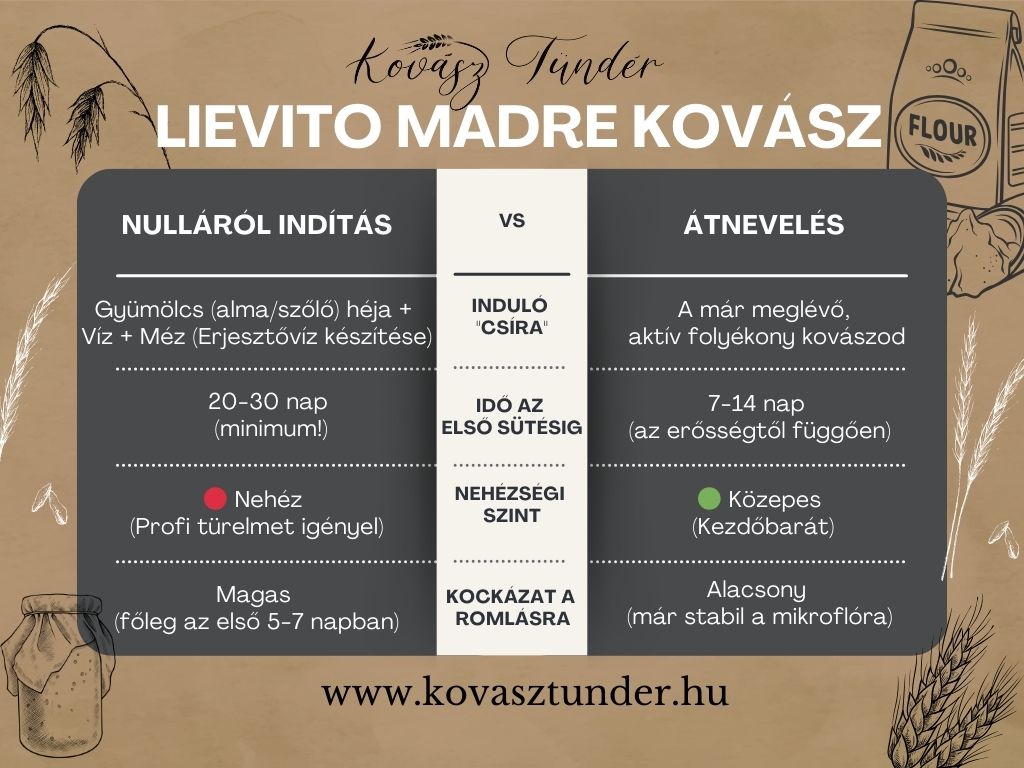
Many of you have heard horror stories about 30-day processes, honey water and mouldy experiments. But here's the good news: there is more than one way! I've made a comparison chart for you so you can clearly see the difference between Conventional (Start from zero) and the Practical (Re-education) method between.
Let's take a closer look at what the data in the table mean!
1. Starting from zero
This is the traditional Italian method. A beautiful process, a real alchemy, but not for everyone.
- The initial "Chira": Here we leave ourselves to nature. We use wild yeasts found on the skin of fruits (usually apples or grapes). We soak them in honey water and use a so-called "yeast yeast". fermentation water we make. Use this to mix in the first portion of flour.
- Time factor: This is a school of patience. You can see it in the table: minimum 20-30 days. Why? Because you have to build a complete microflora from scratch. In the first 1-2 weeks, the sourdough still weak, unstable, not suitable for baking.
- Risk: This is the most critical point. In the first 5-7 days, until the medium is sufficiently acidified, "bad" bacteria and mould can easily colonise. Many times you have to throw it out and start again.
- Who do I recommend? For the experimentalists who love chemistry and are not pressed for time.
2. The "Fairyland" way: re-education
I recommend this method to most home bakers. Why work twice as hard when you already have a treasure in your fridge?
- The initial "Chira": We are not starting from scratch, but from our existing, active, liquid sourdough we use. It already has LIFE in it! Millions of yeast and lactic acid bacteria just waiting to get to work.
- Time factor: Since the "team" is already there, they just need to be acclimatised (re-educated) to the new, tougher environment. This will drastically shorten the time: 7-14 days we could have a Lievito Madre with buffalo.
- Risk: Since your mother casing is already acidic and stable, mould has no chance. The risk of spoilage is minimal, and a successful experience is almost guaranteed.
- Who do I recommend? For beginners, advanced users, and anyone who already has a wild boar and wants to start baking with it as soon as possible.
Which one should I choose?
As the table above shows:
- If the full tradition you're looking for and have the time: choose to start from scratch.
- If the safety, speed and practicality you are looking for: choose re-education.
I'll be spending the next few weeks in Method of re-education I will show you step by step, accompanied by videos. I will show you how to turn a flowing "Gizika" into a strong, Italian "Giovanni"! 😉
Get your Manitoba flours ready, we're leaving soon!
Want to learn the steps of re-education? Subscribe to the newsletter or follow the [www.youtube.com/@kovasztunder], so you don't miss the first video!
Subscribe to
